
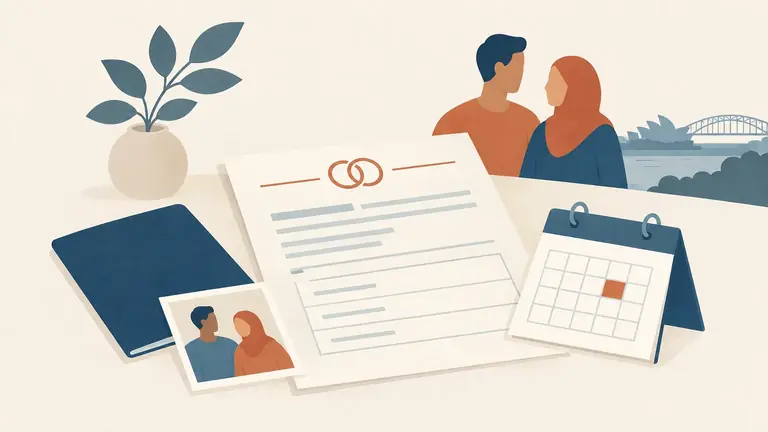
The question is whether the marriage is valid for migration purposes and whether the relationship is genuine and continuing, not who made the introduction.
This page explains what is assessed, what carries weight when the couple married soon after meeting, and where the law draws the line between an arranged marriage and a forced one. It sits under partner visas for different kinds of couples.
Is an arranged marriage recognised for a partner visa?
If the marriage is valid, yes. Validity is a separate question from genuineness, and it turns on the law of the place where the marriage was performed, read with section 12 of the Migration Act and Part VA of the Marriage Act 1961. That test applies in the same way to arranged and unarranged marriages; overseas marriages works through it in full.
Assuming the marriage is valid, the applicant is assessed as a spouse under section 5F. Section 5F(2) requires that the couple are married under a valid marriage, have a mutual commitment to a shared life as a married couple to the exclusion of all others, that the relationship is genuine and continuing, and that they live together or do not live separately and apart on a permanent basis. Those are the married spouse requirements, and they are the whole of the relationship test.
Key facts
the Migration Act and the Migration Regulations contain no reference to courtship, dating, introductions or family involvement. A case officer is not permitted to treat an arranged marriage as a lesser marriage, and the Department's own published criteria say only that the relationship must be genuine.
What does the Department actually assess?
Regulation 1.15A of the Migration Regulations tells the Minister how to decide whether the section 5F conditions exist. For a Partner (Temporary) (Class UK) application — the class the subclass 820 sits in — the Minister must consider all of the circumstances of the relationship, including four matters: the financial aspects, the nature of the household, the social aspects, and the nature of the couple's commitment to each other. Each is broken down further, into fourteen sub-matters in all.
Two of those sub-matters — the duration of the relationship, and the length of time the couple have lived together — are where a short courtship shows up. They are two items in a list of fourteen, and they are weighed with everything else. The genuine and continuing relationship page explains how the four headings are assessed together.
What evidence carries a short relationship?
Where the couple married within weeks or months of being introduced, the file cannot rely on years of shared history, so it has to be dense in other ways.
Family involvement. In an arranged marriage the families are usually the best-documented part of the story and the part applicants most often leave out. Provide correspondence between the families, photographs of the introduction and engagement, the relatives who travelled, and statements from family members on both sides. Relatives who are Australian citizens or permanent residents can provide Form 888 statutory declarations.
The ceremony and its paper trail. The invitation, the guest list, receipts for the venue, catering, clothing and jewellery, who paid for what, photographs showing both families present, and the certificate issued afterwards. Receipts do double duty: they are social evidence and financial evidence at once.
Communication. Continuous contact from the introduction through to lodgement is usually the strongest single body of material a recently married couple has. Provide a dated sample across the whole period, and include calls, not only messages.
Joint plans and money. A joint account, transfers between you, money supporting one household, wedding costs shared, a lease or property arrangement, insurance or superannuation nominations, and a specific answer to where you will live and how. Gifts and payments exchanged between the families should be described plainly and, where possible, evidenced.
Sort the material under the four headings in relationship evidence rather than uploading it chronologically, and see how much evidence to provide first.
How do you explain a short relationship honestly?
Say what happened, with dates, in both personal statements: who introduced you and when, what contact followed, when each of you agreed to the marriage, when the families met, when the ceremony was held, and what you have done since to build a shared life. If you spent only a few days together in person before the wedding, write that. A relationship statement that matches the documents is worth more than one that smooths the timeline.
The risk in a short-courtship application is not the shortness. It is inconsistency — two statements giving different dates, a statutory declaration describing a courtship neither applicant mentions, or a claimed period of living together the tenancy records contradict. That is what gets tested at partner visa interviews, and it is a recurring theme in why 820 visas are refused. If you are still living apart, see evidence when you live apart.
Where is the line between an arranged marriage and a forced marriage?
Consent. In an arranged marriage the families introduce and organise; both people freely agree. A forced marriage is one a person has not freely and fully consented to.
Under section 270.7A of the Criminal Code, a marriage is a forced marriage if a party entered it without freely and fully consenting because of coercion, threat or deception, or because they were incapable of understanding the nature and effect of the ceremony, or if a party was under 16. Section 270.7B makes it an offence to cause a person to enter a forced marriage, and an offence to be a party to one other than as the victim. Both carry years of imprisonment. Separately, section 23B of the Marriage Act makes a marriage void where consent was obtained by duress or fraud, and a void marriage cannot support a spouse application at all.
If you are being forced into a marriage, or you are already in one, help is available and you do not need to be an Australian citizen to get it. In an emergency, call the police on triple zero. The Australian Federal Police investigate forced marriage, and the Attorney-General's Department publishes information about forced marriage and the support that exists for people affected by it. You do not have to resolve anything about a visa first.
Getting the application right
An application prepared by an immigration lawyer is more likely to succeed here, for a reason particular to arranged marriages: the two things most often thin in these files are the validity paperwork for a wedding held overseas and the financial heading, because the money sits with the families rather than in a joint account. Both are awkward to fix after lodgement. No one can promise an outcome.
What to do next
Confirm the marriage is valid where it was performed — start with overseas marriages. Then build the file under the four matters in regulation 1.15A, writing the two personal statements first so the documents can be checked against the account. If your ceremony was religious or customary rather than registered with a civil authority, read cultural and religious marriages next.
Common questions
Can you get an Australian partner visa if your marriage was arranged?
Yes. Nothing in the Migration Act 1958 or the Migration Regulations 1994 refers to how a couple met or who introduced them. The Department must be satisfied that the marriage is valid for migration purposes and that the four conditions in section 5F of the Migration Act are met, including that the relationship is genuine and continuing and that there is a mutual commitment to a shared life as a married couple to the exclusion of all others. An arranged marriage can satisfy all of that.
Does a short time between meeting and marrying hurt a partner visa application?
It does not disqualify anyone, but it changes where the weight sits. Regulation 1.15A of the Migration Regulations lists the duration of the relationship and the length of time the couple have lived together among the matters the Minister must consider, so a short courtship means the other material has to do more work. Communication records, family involvement, the ceremony, joint financial arrangements and concrete plans for living together are what carry the application.
Will we be interviewed because our marriage was arranged?
There is no rule that says so. The Department can interview either or both people in any partner visa application, and it more often does so where the written evidence leaves questions open. The best protection is a consistent, dated account of the relationship in both personal statements and in the supporting statutory declarations, so that an interview confirms what the file already says.
Is an arranged marriage the same as a forced marriage?
No. An arranged marriage is one in which families introduce the couple and help organise the match, but both people freely consent. A forced marriage is one a person enters without freely and fully consenting, because of coercion, threat or deception, or because they could not understand the nature and effect of the ceremony. Forced marriage is a criminal offence in Australia under Division 270 of the Criminal Code.
What if the wedding was held overseas and the certificate is not in English?
The Department needs the marriage documented and translated. Provide the certificate issued by the authority of the country where the marriage took place, together with an English translation, and keep the registration details consistent with every other document in the application. Whether the marriage itself is recognised in Australia depends on the law of the place where it was performed.
Sources
Keep reading

Partner Visas for Same-Sex Couples
Same-sex couples apply for the 820 and 801 on exactly the same criteria — what the Migration Act says, and how to evidence a relationship that had to be hidden.
Read the guide →
Getting Married in Australia Before Applying (NOIM)
The Notice of Intended Marriage, the one-month notice period, who can marry you, and what marrying in Australia does and does not do for a partner visa.
Read the guide →
Is Your Overseas Marriage Recognised in Australia?
The test for recognising an overseas marriage for a partner visa — section 5F(2)(a), section 12 of the Migration Act, Part VA of the Marriage Act, and the exceptions.
Read the guide →