
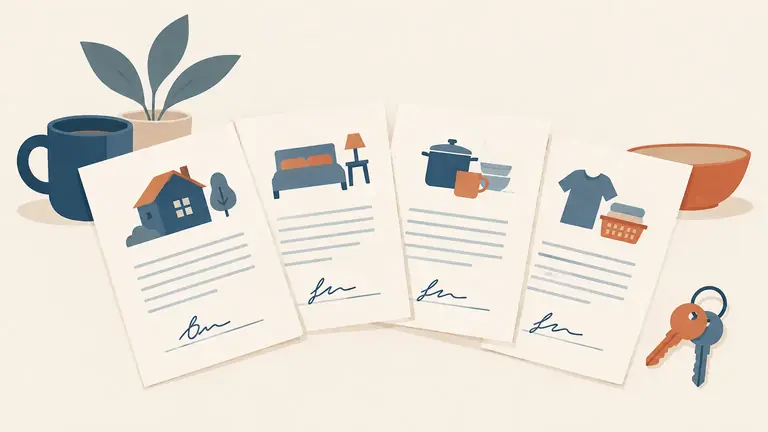
Both list it as including any joint responsibility for the care and support of children, the living arrangements of the persons, and any sharing of the responsibility for housework.
What is the Department working out from household evidence?
Whether two people actually run a life in the same place — not simply whether they have an address in common, but whether the day-to-day business of a home is shared between them.
That is why the regulation puts children, living arrangements and housework in the same list. A shared address is the easiest part to document and the easiest to arrange artificially. The other two items describe how the household actually works, and they are what the personal statements exist to explain. The framework for all four matters is on relationship evidence.
The living arrangements of the persons
The strongest evidence of living arrangements is a run of independent documents putting both people at the same address across time.
The centre of it is usually a tenancy or ownership record: a lease naming both tenants, a residential tenancy bond lodgement in both names, a rental ledger, or a mortgage and title record. Around that sit the documents that accumulate on their own — home and contents insurance covering both of you, utility, internet and council accounts, bank and superannuation statements posted to that address, licence and vehicle registration records, electoral enrolment, Medicare correspondence, and employer records showing the address.
What persuades is the spread, not the volume. One item per quarter from a different source, across every year, does more than fifty pieces of mail from one month. Lay them out chronologically and the address history tells itself.
Watch out
A gap in the address history is read as a period the file does not account for. If you moved, stayed with family, or one of you worked away, say so in the statements and give the dates — an explained gap is a fact, an unexplained one is a question.
Joint responsibility for the care and support of children
This item applies where there are children, whether they are children of both of you, a child of one partner, or a child being cared for in the household.
The documents are institutional. A birth certificate naming both parents is the clearest. Beyond that: school or childcare enrolment forms listing both adults as parents, guardians or emergency contacts; medical and immunisation records; parenting plans or court orders; Services Australia records of the family arrangement; and travel consents or insurance policies covering the child. Where one partner is a step-parent, the everyday material carries the weight — being on the school pick-up list, attending appointments, paying school costs. Enrolment is covered on school enrolment for children.
Children matter again at the permanent stage. Clause 801.221(6) of Schedule 2 to the Migration Regulations allows a subclass 801 to be considered where the relationship has ceased and the applicant has custody of, access to, or a residence or contact order relating to a child for whom the sponsoring partner has a corresponding court order or maintenance obligation — set out on the child of the relationship provision. It is a reason to keep these records properly.
Sharing the responsibility for housework
This is the item people skip, because no organisation issues a document for washing up. It is answered by description, corroborated where possible.
The applicant's and sponsor's statements should be specific — who cooks, who does the laundry, who handles the shopping, who organises repairs, and how that has changed with work or study or illness. "We share the housework" says nothing. "He cooks on weeknights because I finish at seven, and I do the washing and the yard on Saturdays" describes a household.
Corroboration comes from people who have been inside it. The Form 888 statutory declarations are the natural place for a friend, parent or housemate to say what they have seen of how the home runs. Receipts and bookings help: a cleaner or removalist booked in one name and paid from the other's account, appliance purchases, furniture delivered to the shared address.
Which documents evidence which item?
| Document | Item it speaks to | What it shows |
|---|---|---|
| Lease naming both tenants | Living arrangements | A landlord holds you both responsible for the home |
| Bond lodgement or rental ledger | Living arrangements | A dated state record of the tenancy |
| Mortgage or title in both names | Living arrangements | Shared ownership of the home |
| Home and contents insurance, both named | Living arrangements; responsibility | An insurer treats the home as shared |
| Utility, internet and council accounts | Living arrangements | Running the same household over time |
| Mail from banks, employers, agencies | Living arrangements | Independent sources confirming the address |
| Licence, vehicle registration, electoral roll | Living arrangements | Government records of the same address |
| Removalist invoices, furniture delivery | Living arrangements | The move itself, with a date |
| Child's birth certificate | Care of children | Legal parentage |
| School or childcare enrolment forms | Care of children | Both adults recognised in the child's life |
| Medical, immunisation, parenting records | Care of children | Shared day-to-day responsibility |
| Statements from people who visit the home | Housework; living arrangements | First-hand observation of the household |
None of these is a required document. The Department's lodgement requirements concern the sponsorship form, evidence of the sponsor's status and, for applicants without a substantive visa, statutory declarations — not any particular household record. The general list is on 820 visa document checklist.
What if only one name is on the lease or title?
This is the most common household gap, and it has a straightforward answer: evidence the occupancy rather than the contract.
Four things usually do it. Ask the agent or landlord for a short written confirmation of who has lived at the property and over what dates. Add the other partner to the lease, the bond or the utility accounts from now on, so there is a documented change with a date. Build the address history from sources that do not depend on the lease — bank, employer, Medicare, licence, electoral roll. And explain the reason in the statements, because there usually is one: the tenancy predates the relationship, the property belongs to a family member, or the rental market made it simpler. Steps for putting joint names on things are on joint accounts and leases.
Living with family or in shared housing
Neither arrangement weakens an application, and both are normal for couples who are saving or newly arrived.
Where you live with a parent or relative, the household head can provide a statement covering the period, the arrangement and what the couple contribute, alongside whatever mail already places you both there. Where you live in a share house, the co-tenants can describe the household from close range, and a lease listing all occupants does the same work as a two-name lease. In both cases the statements should describe the space you occupy as a couple and how costs are handled, which also feeds the financial aspects evidence.
Periods of living apart — work away, study, caring for a relative overseas, a visa that forced someone offshore — are dealt with on evidence when you live apart. The length of time a couple have lived together is expressly one of the matters, so those dates should be stated plainly and consistently wherever they appear.
An application prepared with a migration lawyer is more likely to succeed on this matter, because the household section is where inconsistency does the most damage: a move-in date in the statement that does not match the lease, or an address history with a year missing, is noticed immediately by an experienced reader and rarely by the couple.
What to do next
Build the address history first, year by year, and only then fill in children and housework. Check it against social context evidence, which often draws on the same statements, and write the living arrangements into the relationship statement so the dates in the documents and the dates in the narrative agree.
Common questions
What counts as evidence of living together for the 820 visa?
Anything that puts both people at the same address, from an independent source, across a run of dates. A joint lease or mortgage, a bond lodgement in both names, a shared home and contents policy, utility accounts, bank and government correspondence addressed to each of you at that address, and licence or electoral roll records are the usual documents. The pattern over time matters more than any single item.
Our lease is only in one name. Is that a problem?
It is common and it is not fatal. Ask the agent or landlord for a written confirmation of who has lived at the property and from when, add the occupant to the lease or the utility accounts from now on, and build the address history from independent mail, bank statements and government records showing both people at the address. Explain in the personal statements why only one name is on the agreement.
Do we have to live together to get an 820 visa?
Living arrangements are one item within one of the four matters, and the decision maker must consider all of the circumstances of the relationship. Married applicants have no separate cohabitation requirement, and for de facto applicants the regulations require a relationship of at least 12 months in most cases rather than 12 months of living together. Periods apart need to be explained and evidenced.
How do we evidence housework when there is no document for it?
Through description rather than documents. The applicant's and sponsor's statements should say who does what, in specific terms, and the supporting statements from people who have been in the home can confirm it from their own observation. Receipts for cleaning, repairs or shared household purchases, and service bookings in each of your names, give the description something to sit on.
We live with my parents. Does that weaken the application?
No. Many couples live with family, especially early on or while saving. What the file needs is the same address history from independent sources, plus a statement from the household head confirming the living arrangement and the period, and a description of how the household runs — what the couple contribute, what space they occupy, how costs are handled.
Sources
Keep reading

Financial Evidence for the 820
The five financial items in regulation 1.15A, the documents that evidence each, how to present them, and what to do when you keep your money separate.
Read the guide →
Social Evidence: Proving Your Relationship Is Known
The three social items in regulation 1.15A, who should write a statement, and how to evidence being known as a couple to employers, clubs and agencies.
Read the guide →
Commitment Evidence: Showing a Shared Future
The four commitment items in regulation 1.15A, the documents that show a shared future, and how to evidence companionship and time apart.
Read the guide →