
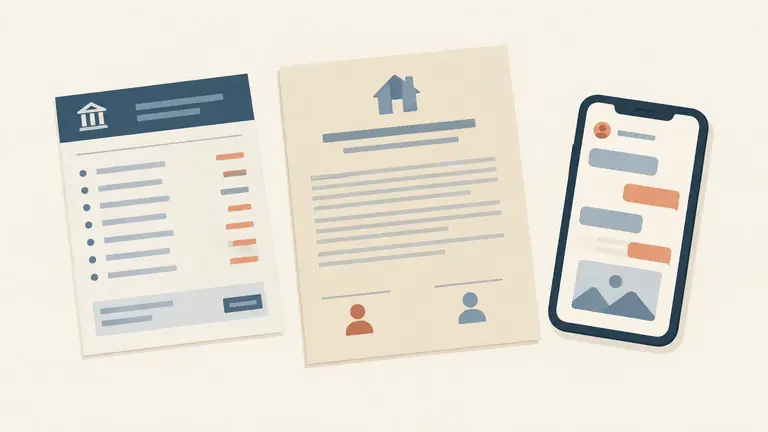
Relationship evidence for a subclass 820 partner visa is organised around four matters set out in the Migration Regulations 1994: the financial aspects of the relationship, the nature of the household, the social aspects of the relationship, and the nature of the couple's commitment to each other. Those headings are not an industry convention. They are written into the regulations, and for a partner visa the decision maker is directed to consider all of the circumstances of the relationship, including those four matters.
Financial Evidence for the 820
The five financial items in regulation 1.15A, the documents that evidence each, how to present them, and what to do when you keep your money separate.
Read the guide →
Nature of the Household Evidence
The three household items in regulation 1.15A, how to evidence a shared address over time, and what to do when only one name is on the lease.
Read the guide →
Social Evidence: Proving Your Relationship Is Known
The three social items in regulation 1.15A, who should write a statement, and how to evidence being known as a couple to employers, clubs and agencies.
Read the guide →
Commitment Evidence: Showing a Shared Future
The four commitment items in regulation 1.15A, the documents that show a shared future, and how to evidence companionship and time apart.
Read the guide →
How to Write a Partner Visa Relationship Statement
What goes in the applicant's and sponsor's relationship statements for an 820 visa, how to structure them, and the mistakes that weaken an application.
Read the guide →
Form 888 Statutory Declarations from Friends and Family
What Form 888 is, who can complete one, what a useful supporting statement says, and why a Form 888 is not a Commonwealth statutory declaration.
Read the guide →
Evidence When You Don't Live Together
Partner visa evidence for couples who live apart — what the Migration Act actually requires, and how to evidence and explain a relationship across two addresses.
Read the guide →
How Much Relationship Evidence Is Enough?
There is no page limit or document quota for partner visa evidence. What decides it is coverage of the four matters, across the whole relationship, at the time of decision.
Read the guide →Where do the four categories come from?
Regulation 1.15A of the Migration Regulations 1994 deals with married couples and regulation 1.09A deals with de facto couples. The two are near-identical.
Regulation 1.15A operates under subsection 5F(3) of the Migration Act 1958. Subregulation (2) says that where the Minister is considering an application for a Partner (Temporary) (Class UK) visa — the class containing the subclass 820 — or the other partner visa classes, the Minister must consider all of the circumstances of the relationship, including the matters set out in subregulation (3). Subregulation (3) then lists the four matters, each with its own sub-items. Regulation 1.09A does the same for de facto partners under subsection 5CB(3). The only substantive difference sits in the social aspects: 1.15A asks whether the persons represent themselves to other people as being married to each other, while 1.09A asks whether they represent themselves as being in a de facto relationship.
Key facts
The four matters, in the words of the regulation, are the financial aspects of the relationship, the nature of the household, the social aspects of the relationship, and the nature of the persons' commitment to each other. Regulation 1.15A(4) adds that for visa classes other than the partner classes the Minister may consider those circumstances. For a partner visa the word is must.
The four matters are how the underlying question is examined, not the question itself. Legal definitions of spouse and de facto sets out the statutory tests, and genuine and continuing relationship explains how the Department approaches the assessment.
The financial aspects of the relationship
Regulation 1.15A(3)(a) lists five things: any joint ownership of real estate or other major assets; any joint liabilities; the extent of any pooling of financial resources, especially in relation to major financial commitments; whether one person owes any legal obligation in respect of the other; and the basis of any sharing of day-to-day household expenses.
Documents that speak to those items include joint bank statements showing both names and both people using the account, a lease or mortgage in joint names, loan or car finance documents, utility and telecommunications accounts in joint names or alternating between you, superannuation and insurance records naming the other person as a beneficiary, a will, and records of regular transfers where expenses are split rather than pooled.
The last item matters for couples who keep separate finances: where each person pays different fixed costs from a separate account, there is still a basis for sharing day-to-day household expenses, and that basis can be described and evidenced. Financial aspects evidence works through each item and the documents that answer it.
The nature of the household
Regulation 1.15A(3)(b) lists three things: any joint responsibility for the care and support of children; the living arrangements of the persons; and any sharing of the responsibility for housework.
Living arrangements are usually evidenced by a joint lease or mortgage, a rental ledger, a bond lodgement showing both names, mail addressed to each person at the same address across a run of dates, a shared home and contents insurance policy, and electoral roll or driver licence records showing that address. Care of children is evidenced by birth certificates, school enrolment forms listing both adults, medical and childcare records, and any parenting arrangements.
Housework is the item people skip, because there is no document for it. It is normally covered in the personal statements and in the Form 888 statutory declarations from people who have been in the home. Nature of the household evidence covers the rest, and evidence when you live apart deals with couples who have not shared an address.
The social aspects of the relationship
Regulation 1.15A(3)(c) lists three things: whether the persons represent themselves to other people as being married to each other (or, under regulation 1.09A, as being in a de facto relationship); the opinion of the persons' friends and acquaintances about the nature of the relationship; and any basis on which the persons plan and undertake joint social activities.
The second item is almost a description of what a supporting statement does, which is why written statements from other people sit here. Beyond those, the useful material is dated and specific: joint invitations, wedding or engagement material, captioned photographs across the years saying who is in them and when and where they were taken, joint travel bookings and boarding passes, membership of clubs as a couple, correspondence addressed to both of you, and evidence of contact with each other's families. Social context evidence covers how to put this together without producing several hundred undated photographs.
The nature of your commitment to each other
Regulation 1.15A(3)(d) lists four things: the duration of the relationship; the length of time during which the persons have lived together; the degree of companionship and emotional support that the persons draw from each other; and whether the persons see the relationship as a long-term one.
Two of those four are dates, which can be documented. The other two are internal to the relationship, and they are what the applicant's and sponsor's own statements exist to explain. Supporting documents include a marriage certificate or relationship registration, evidence of when the relationship became exclusive or the couple began living together, wills, powers of attorney, beneficiary nominations, correspondence during periods apart, and joint plans for the future that have left a paper trail — a home loan pre-approval, a lease renewal, a jointly booked trip. Commitment evidence and the relationship statement page deal with this category together, because most of it lives in the writing rather than in the documents.
How far back does the evidence need to go?
It should cover the whole relationship, not the weeks before lodgement. The duration of the relationship and the length of time the couple have lived together are both expressly listed in regulation 1.15A(3)(d), so the timeline is itself one of the matters being considered.
A practical test is to lay the evidence out by year. If there is material from every stage — the months after the relationship began, the move to a shared address, each subsequent year — the timeline holds together. If everything carries a date within weeks of lodgement, the obvious question is what the relationship looked like before that, and the file does not answer it. Where a category cannot be evidenced for part of the period, explain why in the personal statements.
Does a bigger file make a stronger application?
No. Beyond a point, volume works against quality. A case officer reads what is uploaded, and several hundred pages of message screenshots make it harder, not easier, to find the joint lease and the bank statements that answer the four matters.
The better test is coverage. Does the file contain something for each of the four matters? Does it cover each year? Is every item dated, legible and explained? A focused set that passes that test is usually stronger than an undifferentiated pile. How much evidence to provide works through the trade-off.
The relationship has to be genuine when the decision is made
The subclass 820 criteria are split between those to be satisfied at the time of application and those to be satisfied at the time of decision. Clause 820.221 of Schedule 2 to the Migration Regulations requires that at time of decision the applicant continues to meet the requirements that applied at time of application — that is, continues to be the spouse or de facto partner of the sponsoring partner, with limited exceptions where the sponsor has died or where family violence or certain child custody circumstances apply.
That makes the file a living document rather than a package sealed at lodgement. The Department says that as partner applications can have long processing times you should update your documents and evidence of your relationship regularly through ImmiAccount. Add each year's lease renewal, insurance policy and joint bank records as they arrive, rather than waiting to be asked.
Watch out
Evidence that stops at the lodgement date leaves the most recent part of the relationship — the part closest to the decision — unevidenced. Updating through ImmiAccount as things happen avoids scrambling when the Department writes.
How should the evidence be organised for a case officer?
Organise it so the reader can see, without hunting, which of the four matters each document goes to and when it is from.
- Group by the four matters, not by document type — one set for financial, one for household, one for social, one for commitment.
- Name each file so the name says what it is: category, document, date range, for example
Financial - joint account statements - Jan 2024 to Dec 2024. A file calledscan001.pdfcosts the reader time. - Combine like with like. Twelve monthly statements belong in one named PDF, not twelve uploads.
- Date everything. Undated photographs and screenshots carry much less weight.
- Add a short index saying what has been provided under each matter and over what period.
- Explain anything that looks odd — a gap, a mismatched address, a period apart — in the statements rather than hoping it is not noticed.
The upload mechanics, file limits and document checklist are covered on 820 visa document checklist and lodging in ImmiAccount.
Where applications come unstuck
The common failures are not exotic. Evidence covering only three of the four matters, usually leaving financial or household thin. Statements that contradict the documents, such as a move-in date a year before the lease. Undated material. A file assembled in the fortnight before lodgement, with nothing added afterwards.
An application prepared with an Australian migration lawyer is more likely to succeed here, because the gap applicants cannot see in their own file is the one an experienced reader notices immediately: the matter with no evidence at all, the missing year, or the statement that quietly contradicts a document three folders away.
What to do next
Work through the four matters using the pages above, then write the two personal statements — they tie the documents into a single account. Start with the relationship statement, arrange the supporting statements covered on Form 888 statutory declarations, and check the file against the 820 visa document checklist.
Common questions
What are the four categories of partner visa relationship evidence?
They come from regulation 1.15A of the Migration Regulations 1994 for married couples and regulation 1.09A for de facto couples. The four matters are the financial aspects of the relationship, the nature of the household, the social aspects of the relationship, and the nature of the persons' commitment to each other. For partner visa applications the decision maker must consider all of the circumstances of the relationship, including those four matters.
How far back should relationship evidence go?
It should cover the whole period of the relationship, from around the time it began through to the present. Evidence clustered in the weeks before lodgement invites the question of what the relationship looked like before that. A spread of dated material across each year is more persuasive than a large volume from a single month.
Is more evidence always better?
No. A case officer reads what is uploaded, and a thousand pages of message screenshots can bury the handful of documents that actually answer the four matters. A smaller set that covers all four matters across the whole relationship period, clearly named and dated, is usually stronger than an undifferentiated pile.
Do I need to keep adding evidence after I lodge?
Yes, in practice. The relationship has to still meet the requirements at the time the decision is made, not only at the time of application. The Department says that because partner applications can have long processing times, you should update your documents and evidence of your relationship regularly through ImmiAccount.
What if we have not lived together?
Living arrangements are only one of the items under the nature of the household, and the decision maker must consider all of the circumstances of the relationship. Periods apart need to be explained in the personal statements and supported by evidence of continued contact, visits and shared commitments across that time.
Unregistered agents
An unregistered agent who gives immigration assistance is acting illegally (Migration Act 1958 s 280). They carry no professional indemnity insurance, so if their mistake costs you a refusal, your fees or your pathway, there is no insurer to claim against. A practising Australian lawyer must hold that insurance.